A TRACK 1 AUDIO LISTENING GUIDE
2nd order vs
3rd order harmonics.
Two controls can change the character of a sound in different ways. Here is a practical way to hear what each one is doing.
What does a harmonics plugin do?
A harmonic processor uses a nonlinear response to create additional frequency content. For a simple tone at 100 Hz, the second harmonic is at 200 Hz and the third is at 300 Hz. Real instruments contain many frequencies, so processing a chord or drum hit produces a more complex result than processing a single sine wave.
“Saturation” describes a family of nonlinear effects rather than one fixed sound. The input level, transfer curve, routing and filtering all affect the result. A processor with separate 2nd order and 3rd order harmonics controls gives you another way to shape that character.
2nd order harmonics: the even-order starting point
Load Harmonic Bloom on a spare copy of your track. Begin with the Second and Third controls at zero, then raise Second while keeping Third down. Listen for changes in body, density and texture. “Warm” is a useful listening description, but a setting that feels warm on one instrument may feel crowded on another.
Harmonic generation depends on the level entering the plugin. If a quiet track seems barely affected, compare a more active section before increasing everything at once. Leave output headroom while experimenting.
3rd order harmonics: what 3rd order saturation adds
Return Second to zero and bring up Third. Listen to the attack and upper texture as well as the overall loudness. Avoid assuming that a higher number is an improvement: a small amount may be enough in a dense mix.
On complex material, these labels describe the processing stages; they do not mean the output contains only one extra harmonic. In serial routing, one nonlinear stage feeds another, which changes the interaction between them.
What does “order” mean?
In a harmonics description, order identifies an integer multiple of the fundamental frequency. The 2nd order harmonic is 2f; the 3rd order harmonic is 3f. The fundamental is the first harmonic, so the third harmonic is the second overtone. “3rd order” does not mean three times the loudness or the third knob setting.
| Fundamental (f) | 2nd order (2f) | 3rd order (3f) |
|---|---|---|
| 100 Hz | 200 Hz | 300 Hz |
| 220 Hz | 440 Hz | 660 Hz |
| 440 Hz | 880 Hz | 1,320 Hz |
The second harmonic is an octave above a single fundamental. The third is an octave plus a perfect fifth above it. On an instrument recording, the input already contains many partials, so a nonlinear saturator can also generate interactions between frequencies.
Even-order vs odd-order harmonics
Second, fourth and sixth belong to the even-order family; third, fifth and seventh belong to the odd-order family. Harmonic Bloom focuses on 2nd order and 3rd order processing stages, rather than offering an editor for every even and odd harmonic. A 2nd order setting is not an “all even harmonics” switch, and a 3rd order setting is not an “all odd harmonics” switch.
Words such as warmth, body, edge and presence describe listening impressions, not fixed laws. Input level, source spectrum, processing amount, output level and the rest of your mix determine what you hear. More saturation can also create more peaks or mask detail.
Saturator, saturation, harmonics generator or exciter?
These terms overlap in music production. A saturator applies a nonlinear response that can add harmonics. A harmonics generator emphasizes the added frequency content. “Exciter” commonly describes an enhancement workflow, sometimes with frequency-selective processing. Harmonic Bloom is a full-band harmonic saturation tool; it does not provide a dedicated high-frequency exciter band, a multiband crossover or subharmonic synthesis.
An EQ can boost or cut frequencies already present. Nonlinear saturation can create additional frequencies. A harmonic saturator is also not automatically a compressor or a true-peak limiter. Leave headroom and use a suitable limiter when your delivery requires peak control.
Harmonics, intermodulation and aliasing
A single sine test helps identify harmonics at multiples of one fundamental. With two or more tones, nonlinear processing may also create sum-and-difference frequencies called intermodulation products. Serial stages can generate a broader spectrum than an isolated stage. That is why one control name does not fully describe the sound of a chord or drum bus.
Digital nonlinear processing can generate frequencies above the system’s Nyquist limit that fold back as aliasing. Harmonic Bloom uses 8× oversampling and filtering to reduce this problem; this is not a claim of zero aliasing at every input level and setting. See Analog Devices’ distinction between harmonic and intermodulation distortion for the measurement terminology.
Hear Raw → 50 → 100
Our Harmonic Bloom audio previews let you select drums, guitar or synth, then compare Raw, 2nd order 50/100 and 3rd order 50/100. These are control settings from the recorded examples, not a percentage of added harmonic energy.
Choose one instrument and keep playback volume steady. Listen to a short phrase several times. Compare the 50 setting with Raw before moving to 100; stronger examples make the change easier to identify, while the lower setting may fit a mix more naturally.
LESS READING. MORE LISTENING.
Hear the
color come through.
Raw to warm. Subtle to full.
Your ears can take it from here.
Compare Raw, 3rd order harmonics at 50%, then 100%. These examples use Classic processing.
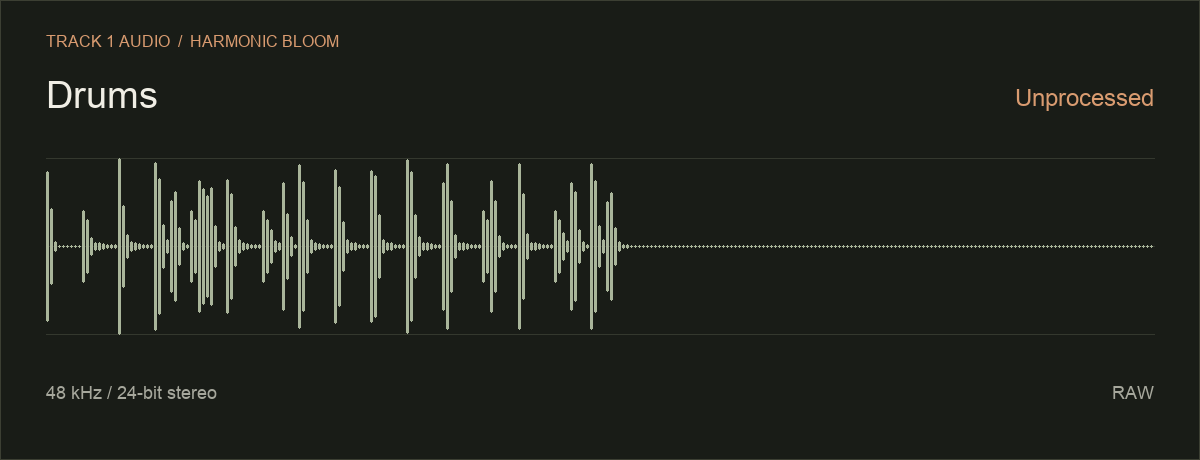
| Instrument | RawOriginal | 3rd order harmonics50% | 3rd order harmonics100% |
|---|---|---|---|
| Drums | |||
| Guitar | |||
| Synth |
Original recordings · 48 kHz / 24-bit stereo · No level normalization
Playback continues through the remaining settings for your selected instrument, then stops. Level differences are part of the examples.
Try it on your own tracks
- Drums: listen to the body of the kick and snare, then check that cymbals still sit where you want them.
- Guitar: compare the pick attack with the sustain. Check chord clarity as you add color.
- Synth: try a simple patch first, then a richer one. Harmonic processing can respond very differently to each.
Use Harmonics gain to adjust the generated branch and Mix to place it beside the clean branch. Solo helps you audition the generated branch; in Classic mode it can also contain fundamental energy, so it is not a filter that isolates only new overtones. Changes in gain and processing can still change total loudness.
Which edition should you start with?
Harmonic Bloom Lite is a free harmonics plugin with Classic serial processing, separate Second and Third controls, Harmonics gain and Solo. Its download needs no email or account. Premium adds Bold mode, parallel routing and six presets for a one-time $10.99 USD purchase.
Mac AUv2 and VST3 and Windows x64 VST3 builds are available as previews. Intel Mac is verified; native Apple Silicon and Windows DAW testing remains pending. Use a spare project when evaluating a preview build.